
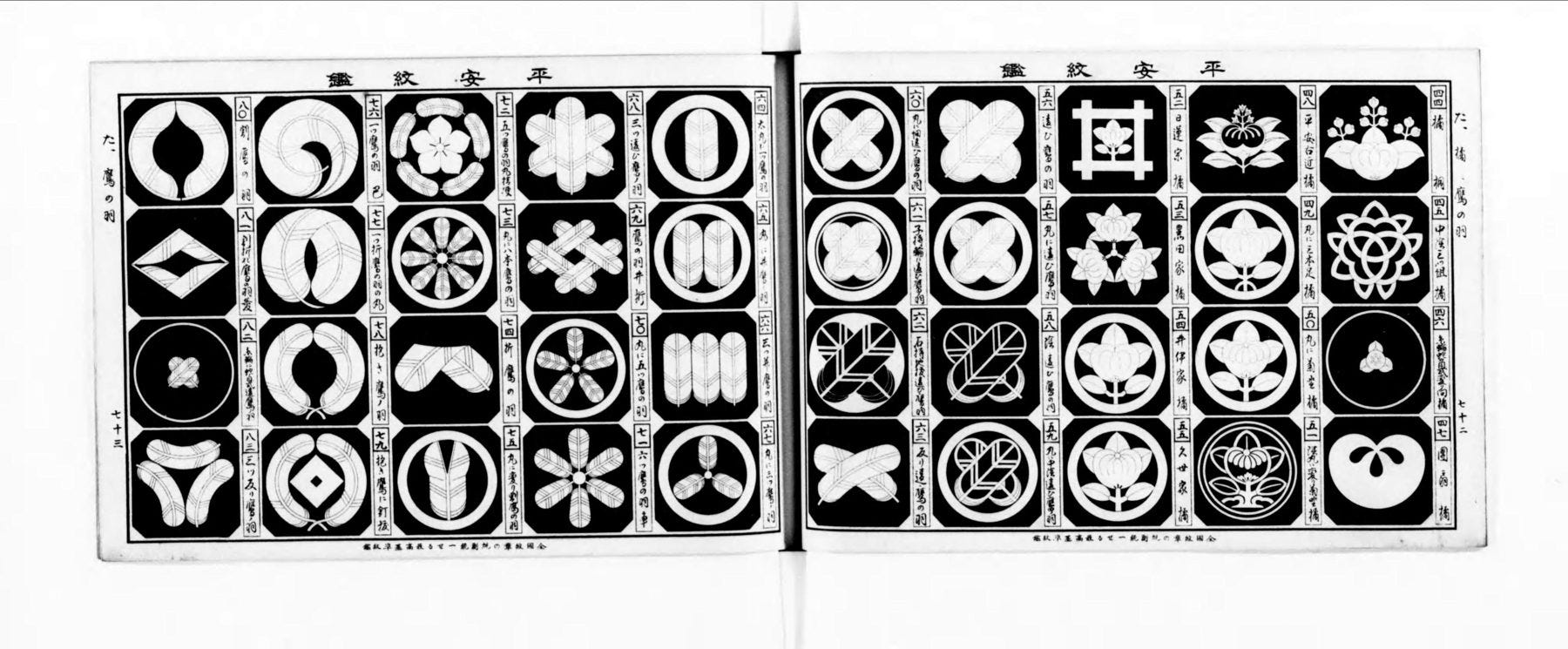
Japan has more than 25,000 family crests, or kamon (家紋).¹ The hawk feather, or takanoha, alone comes in 28 shapes. That is the number on just two facing pages of Heian Monkan, a printed catalog of crests from 1936.
Why did one feather multiply this far? There are only five rules.
A single feather stands for the hawk, not the whole bird
Hawk feathers were the material for arrow fletching. An inventory of treasures given to Tōdai-ji, a temple in Nara, lists arrows fletched with hawk feathers.²
In the Heian period, from the late 8th century to the 12th, military officials of the court wore hawk feathers on both sides of their court caps. Only military officials were allowed this ornament.³ The hawk feather was a military emblem.
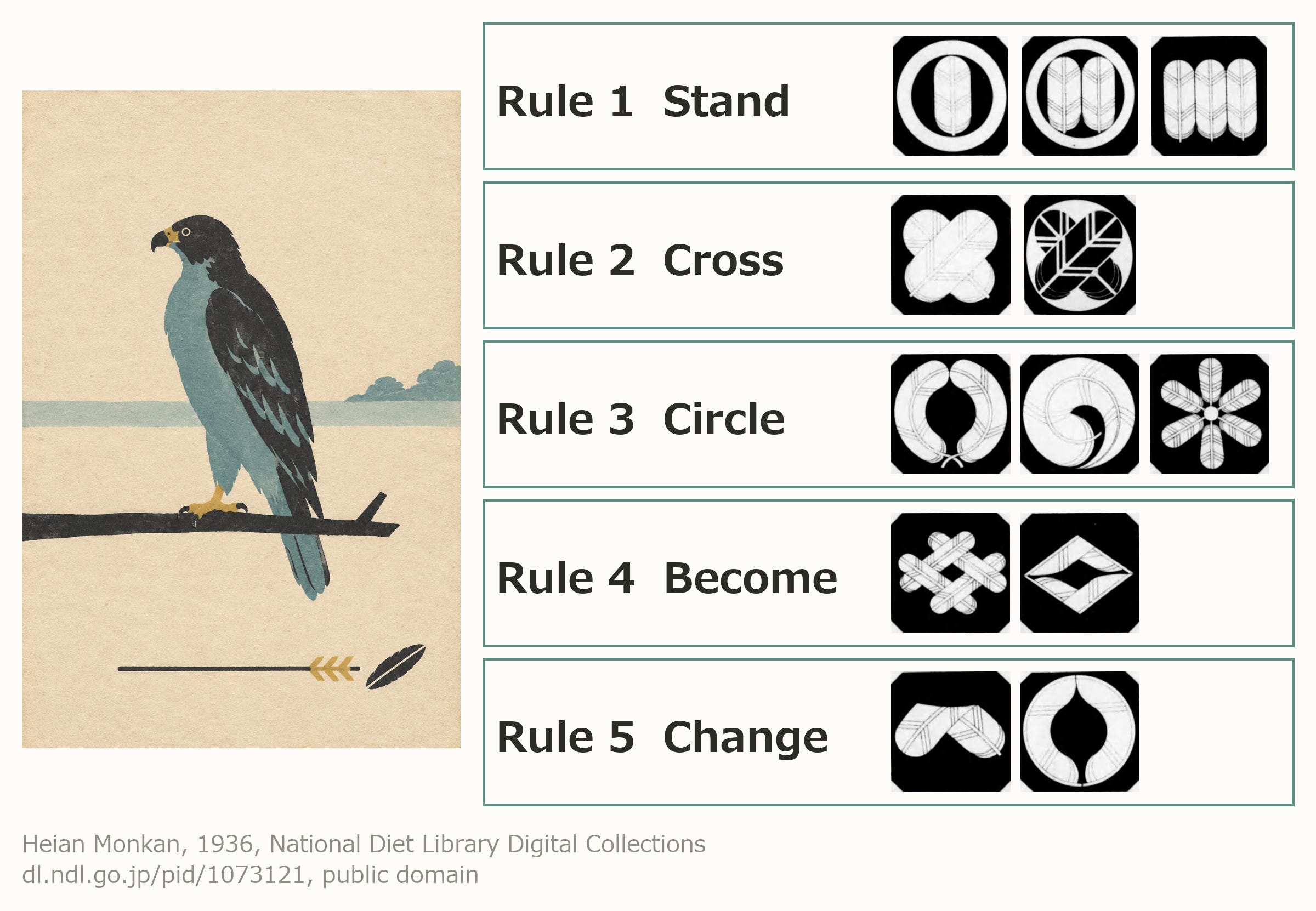
Very few crests show the hawk itself.⁴ For most, a single feather was enough. Western heraldry shows beasts and birds in threatening poses. Japanese crests fitted a single feather into an orderly shape.⁵
This single feather is the starting point of all 28 shapes.
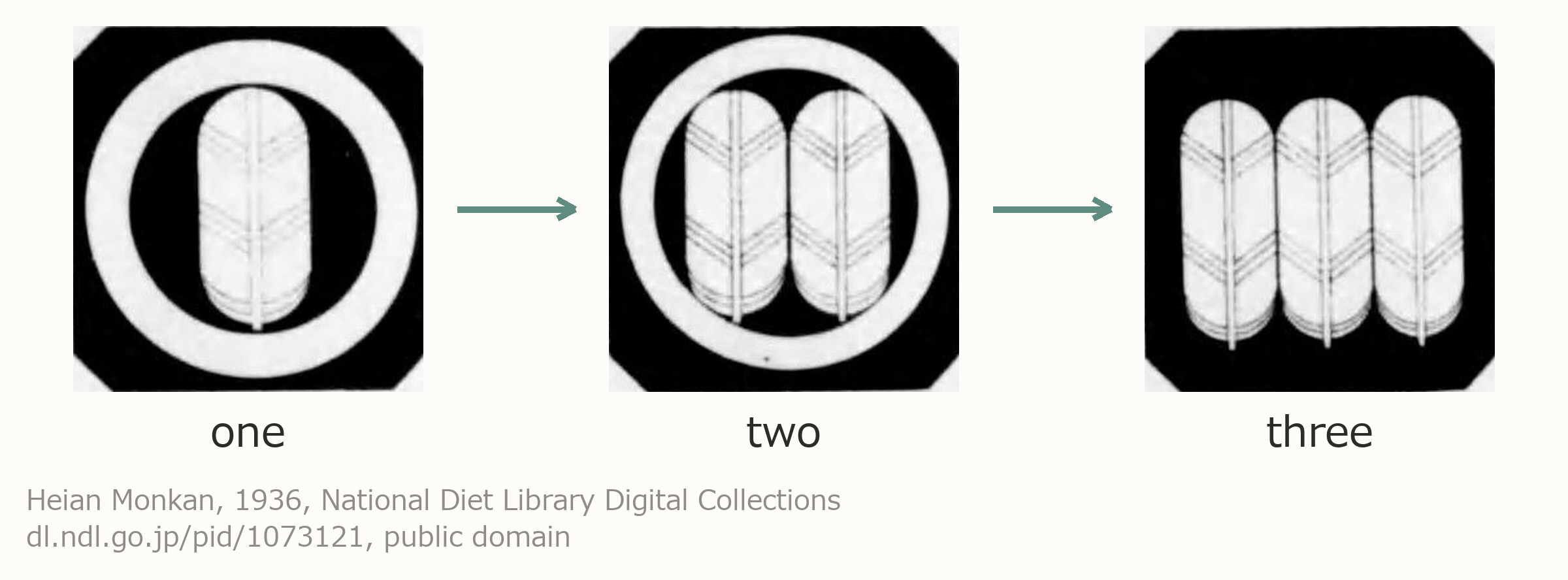
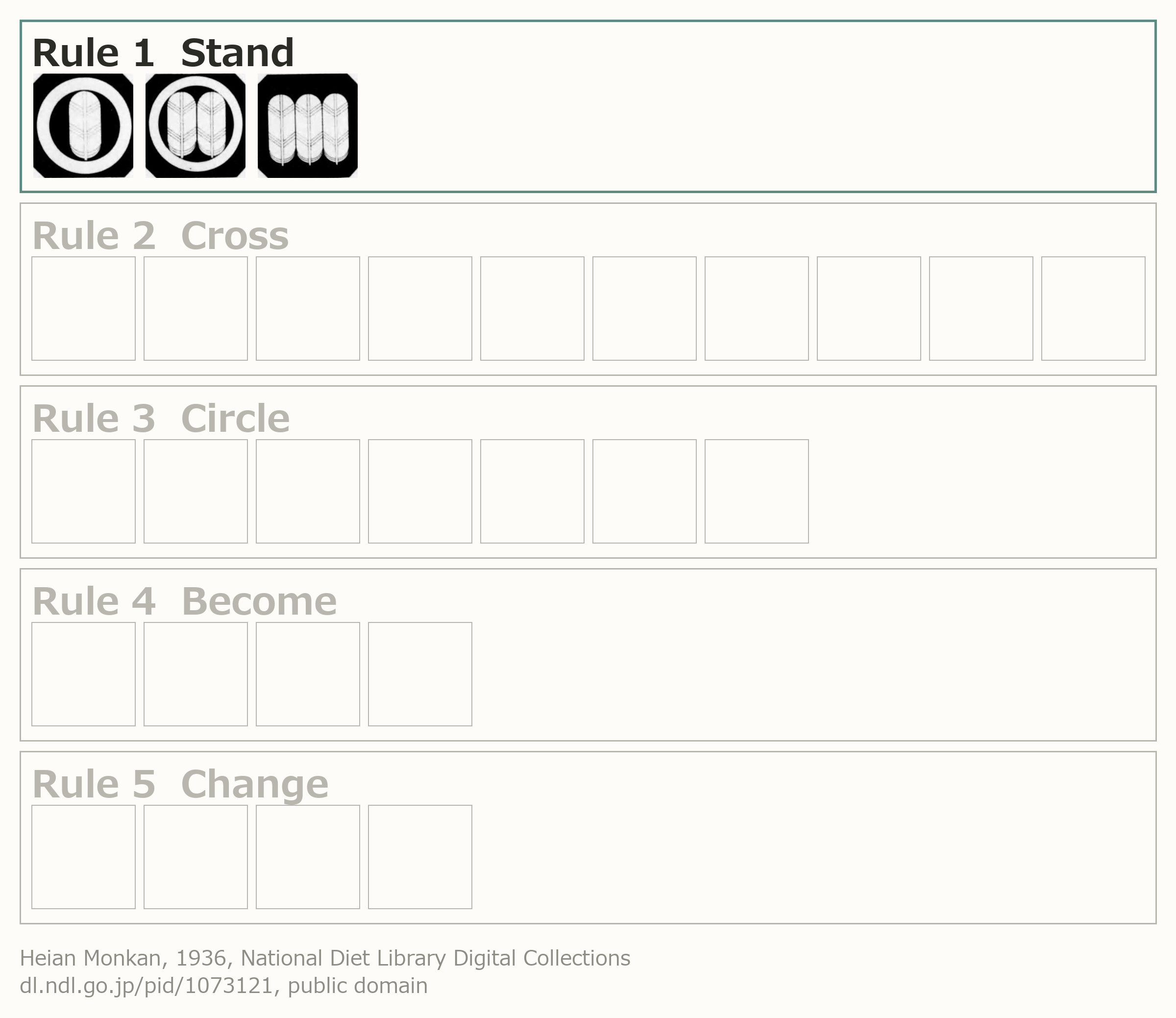
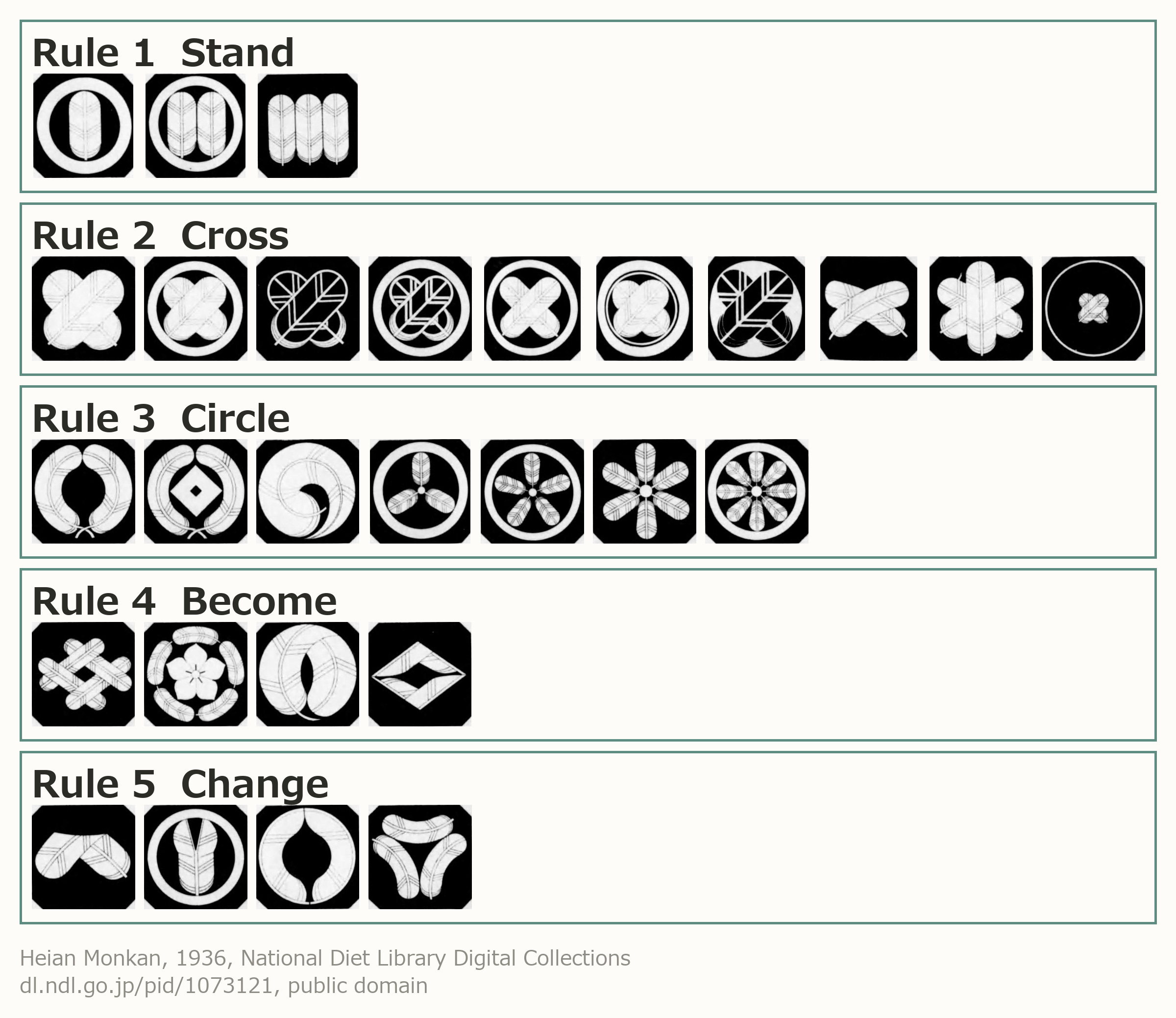
Rule 1 Stand them up: change the number
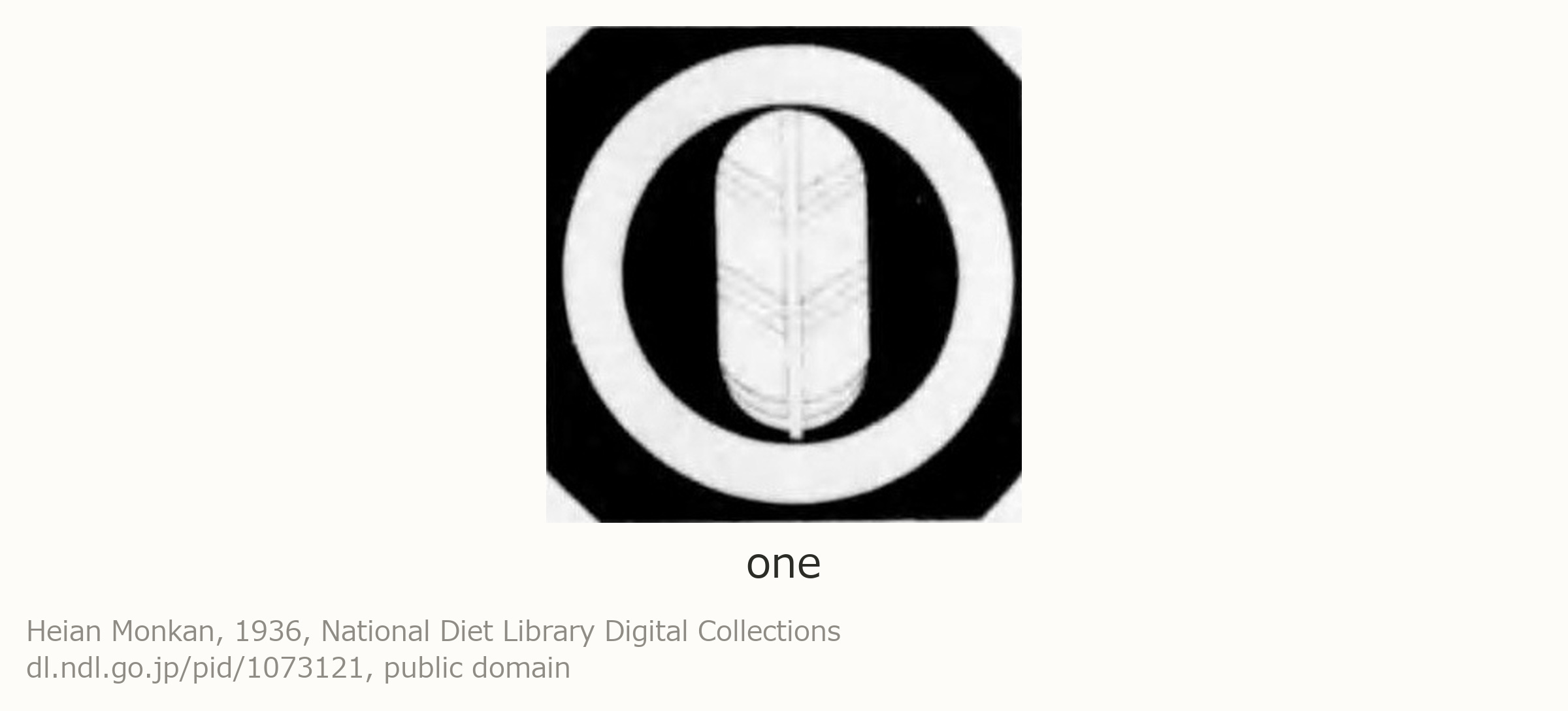
The simplest way to multiply is by number. One feather, two, three. Stand them upright side by side, and each number is a different crest.
Two feathers standing side by side are called Narabi-taka-no-ha, or side-by-side hawk feathers. The earliest hawk-feather crest, in a 13th-century picture scroll, has this shape.
Rule 2 Cross them: two feathers crossed
Cross two feathers at an angle, and you have Chigai-taka-no-ha, or crossed hawk feathers. Seven out of ten hawk-feather crests take this form.¹
The direction of the crossing matters. Does the left feather lie on top, or the right? That alone counts as a different crest.³
The outer ring can change, too. A plain circle, a thin thread ring, a double ring. Reverse the black and white of the feather, and you have the “outline” form. Make the feather thinner, and you have the “thin” form.
Crossed hawk feathers alone account for ten of the shapes on these two facing pages.
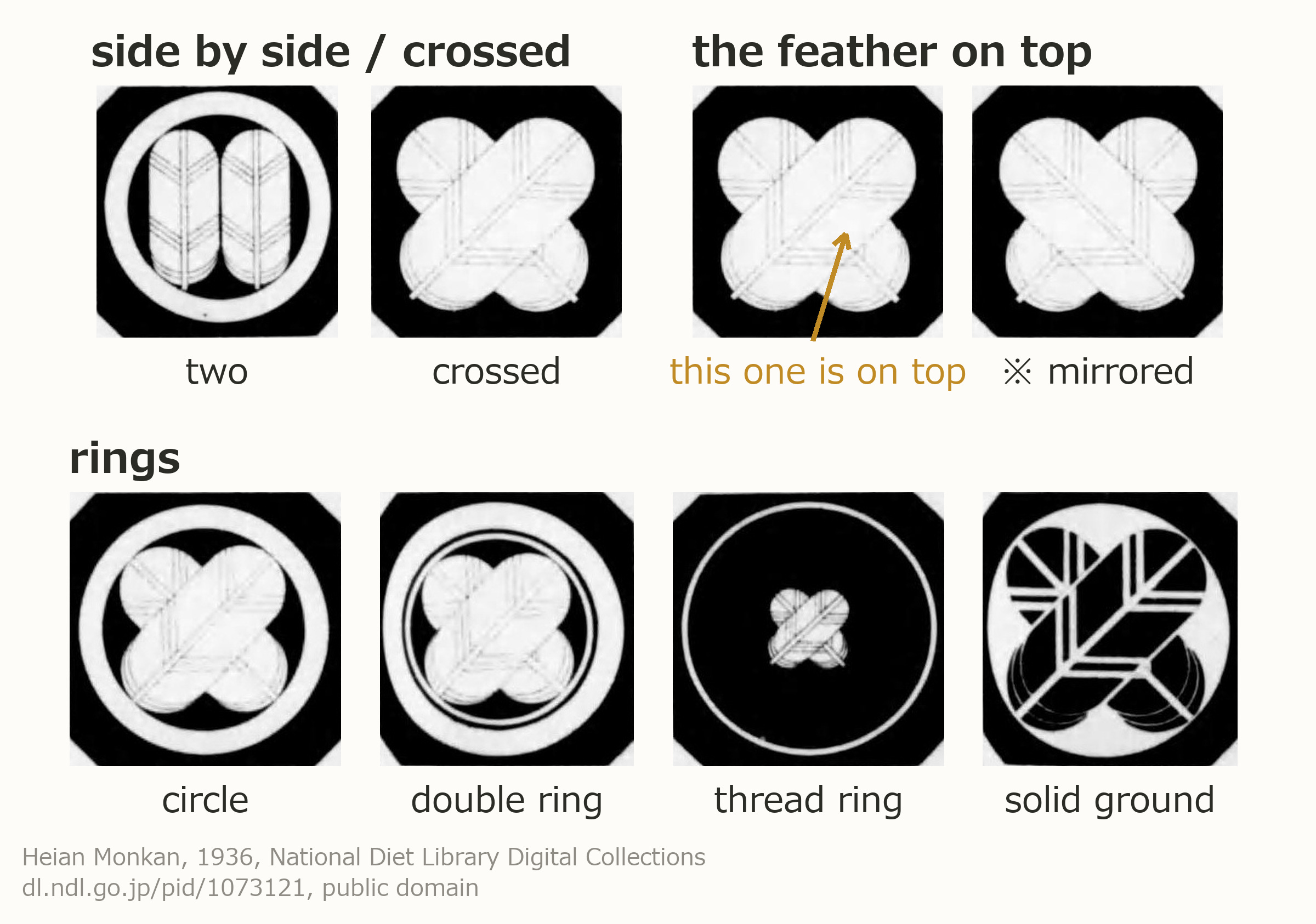
Note: In the figure above, the right-hand crest under “the feather on top” was made by mirroring the crossed hawk feathers from Heian Monkan. It is not a shape found in the catalog. I placed it here to make clear which feather lies on top.
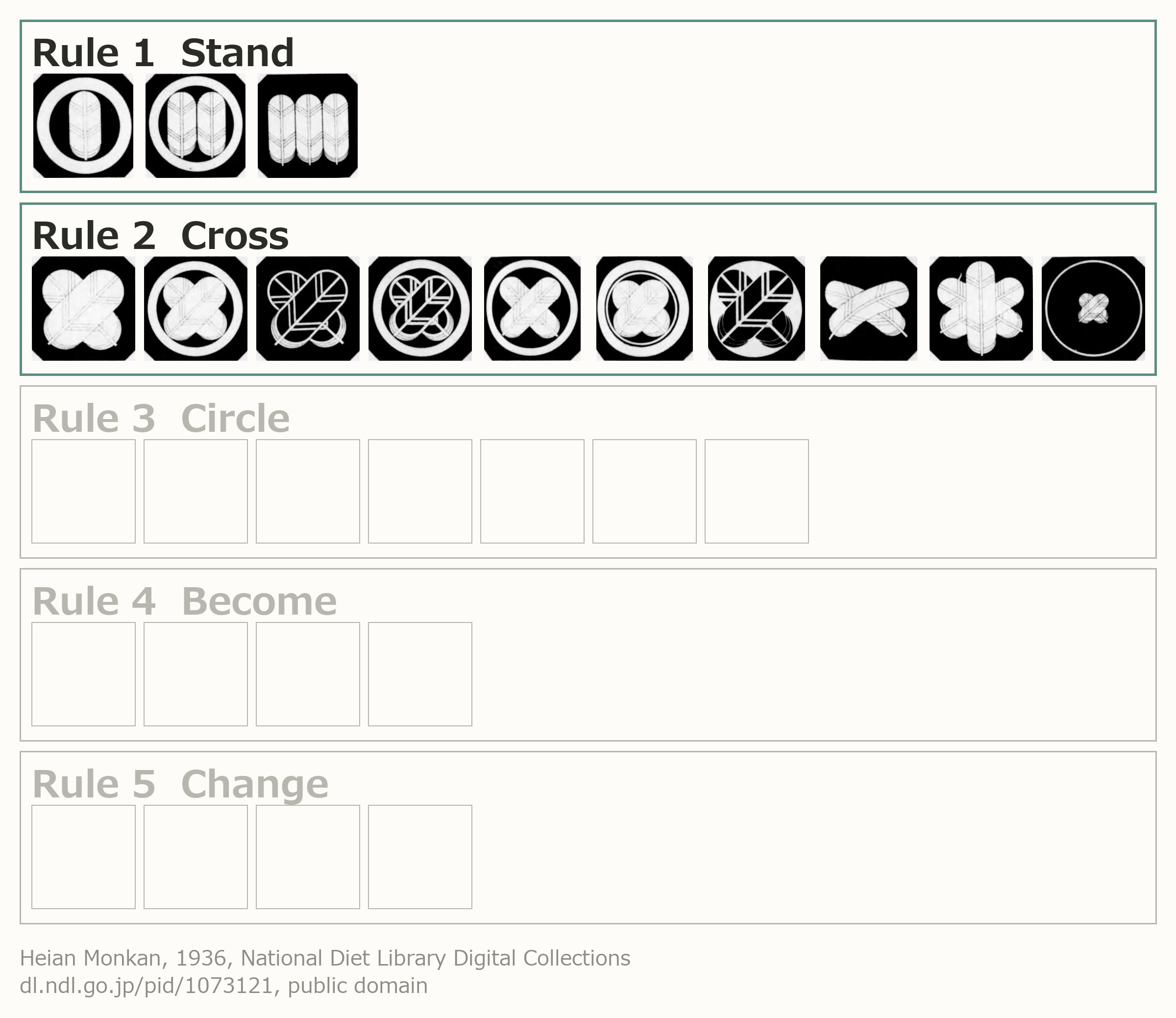
Rule 3 Set them in a circle: embracing, tomoe, wheel
This method places the feathers in a circle.
Bend two feathers to face each other: “embracing.” Curl one whole feather into a comma shape: “tomoe.” Set three, five, six, or eight feathers radiating outward: “wheel.”
When making a wheel, a small circle holds the center together. Without the circle, the shape looks as though it might fall apart.⁶
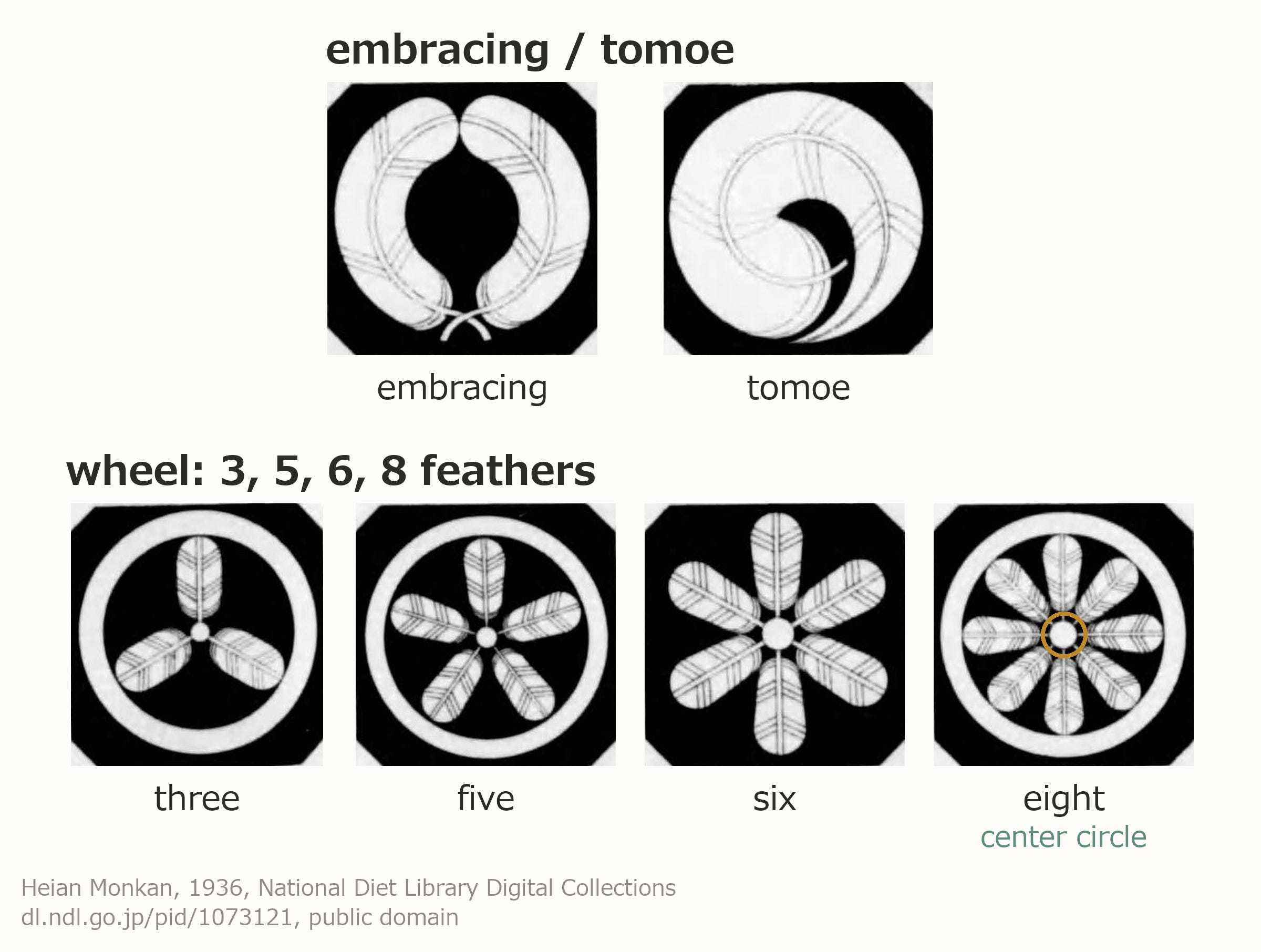
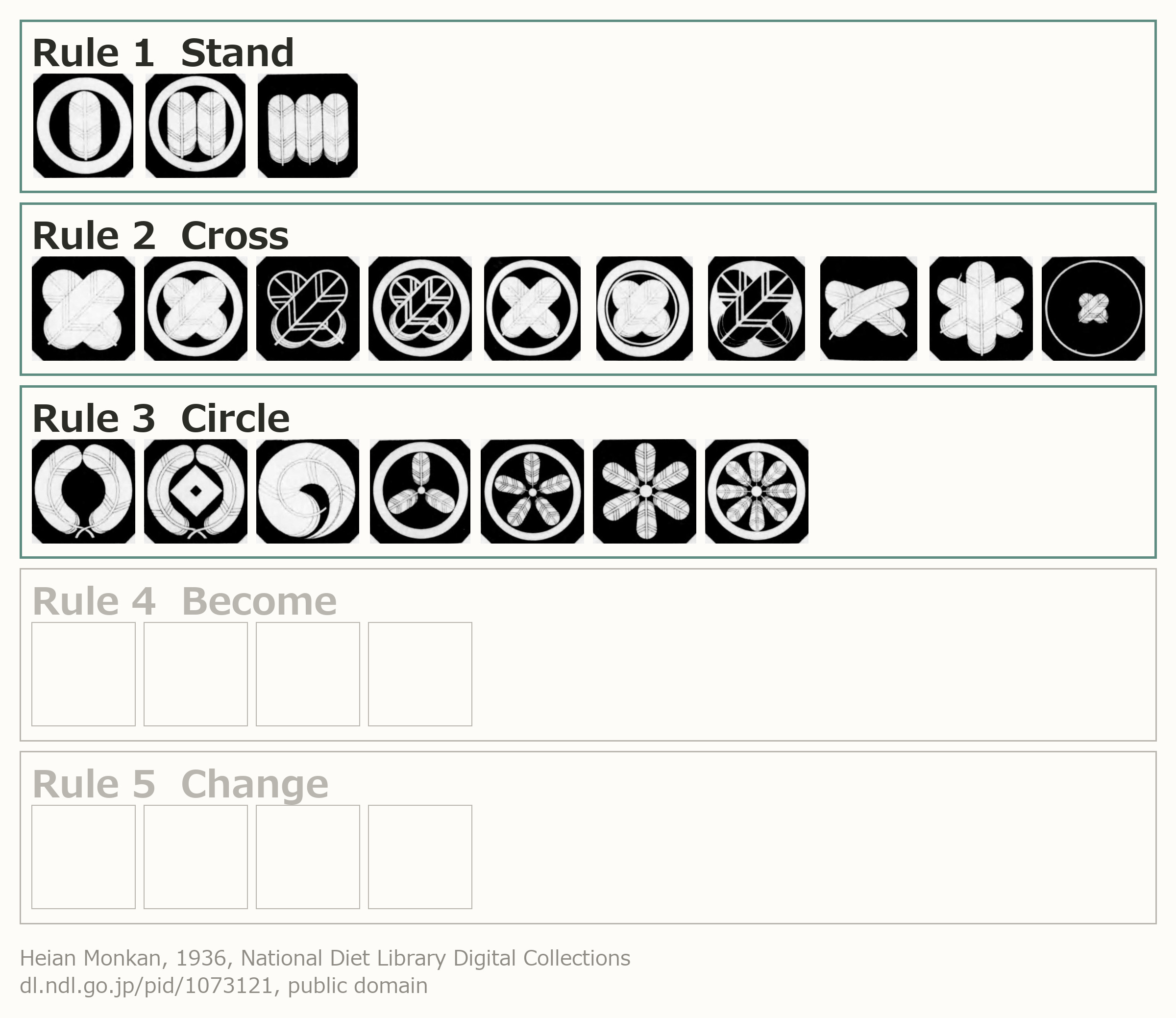
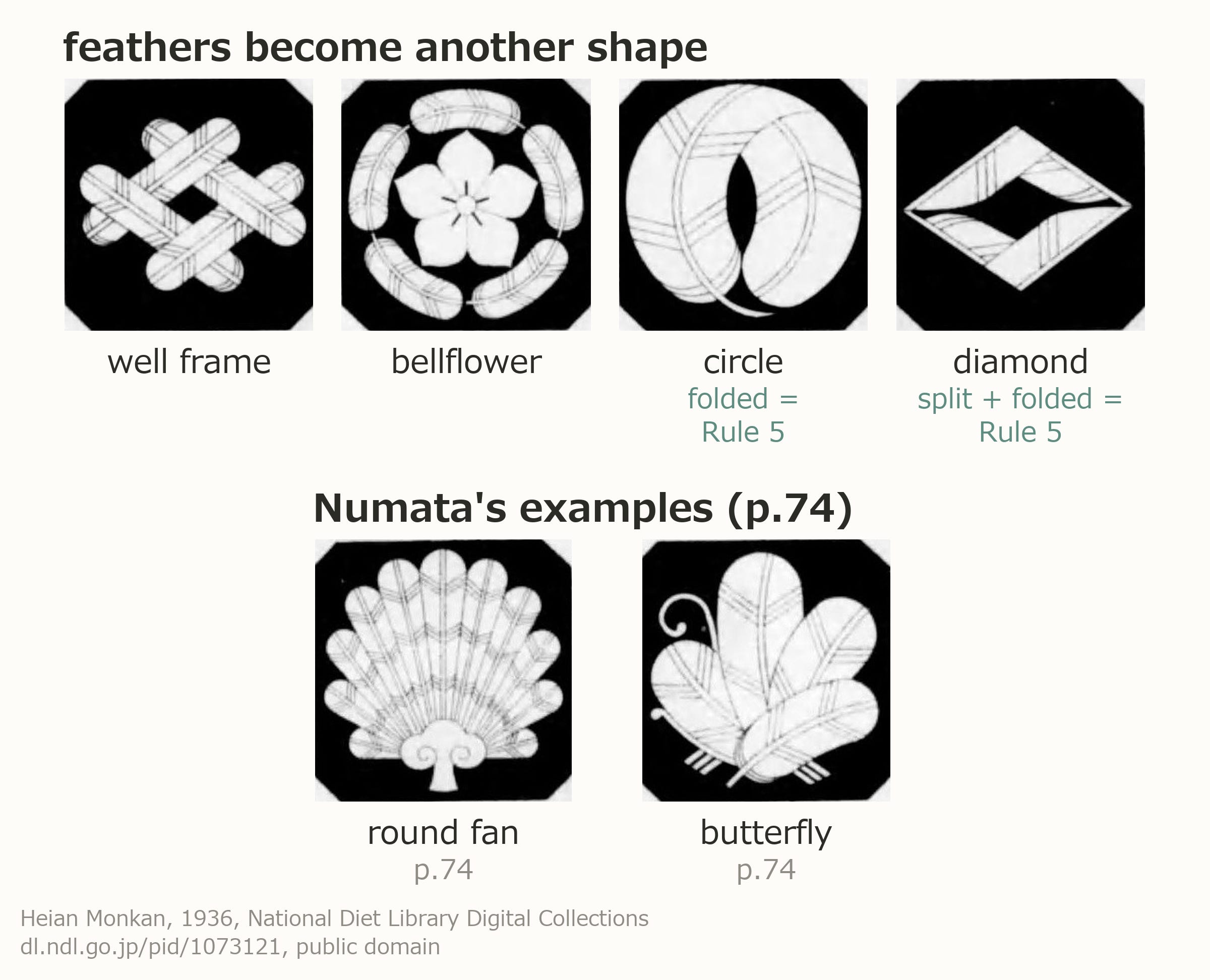
Rule 4 Turn into other things: well frame, diamond, circle
This method combines feathers into the shape of something else.
Combine four, and you have a “well frame,” the shape of the wooden frame around a well. Feathers can also be folded or split to form a circle or a diamond. Folding and splitting are the techniques of Rule 5, coming next. The rules can be combined.
In 1926, Numata Yorisuke listed the round fan, the butterfly, the well frame, and the bull’s-eye ring.³ The feather stays a feather. Only the overall shape becomes something else.
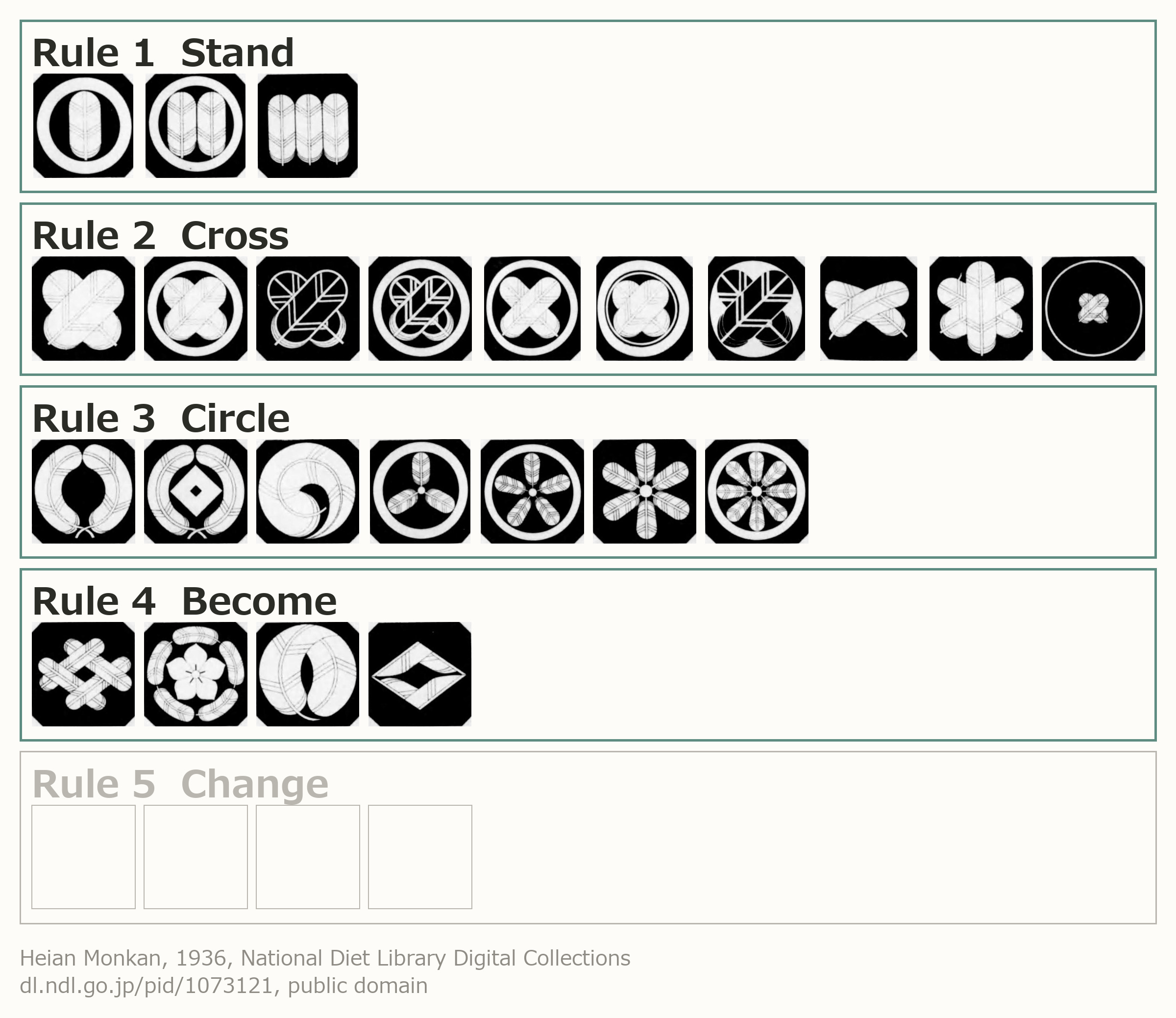
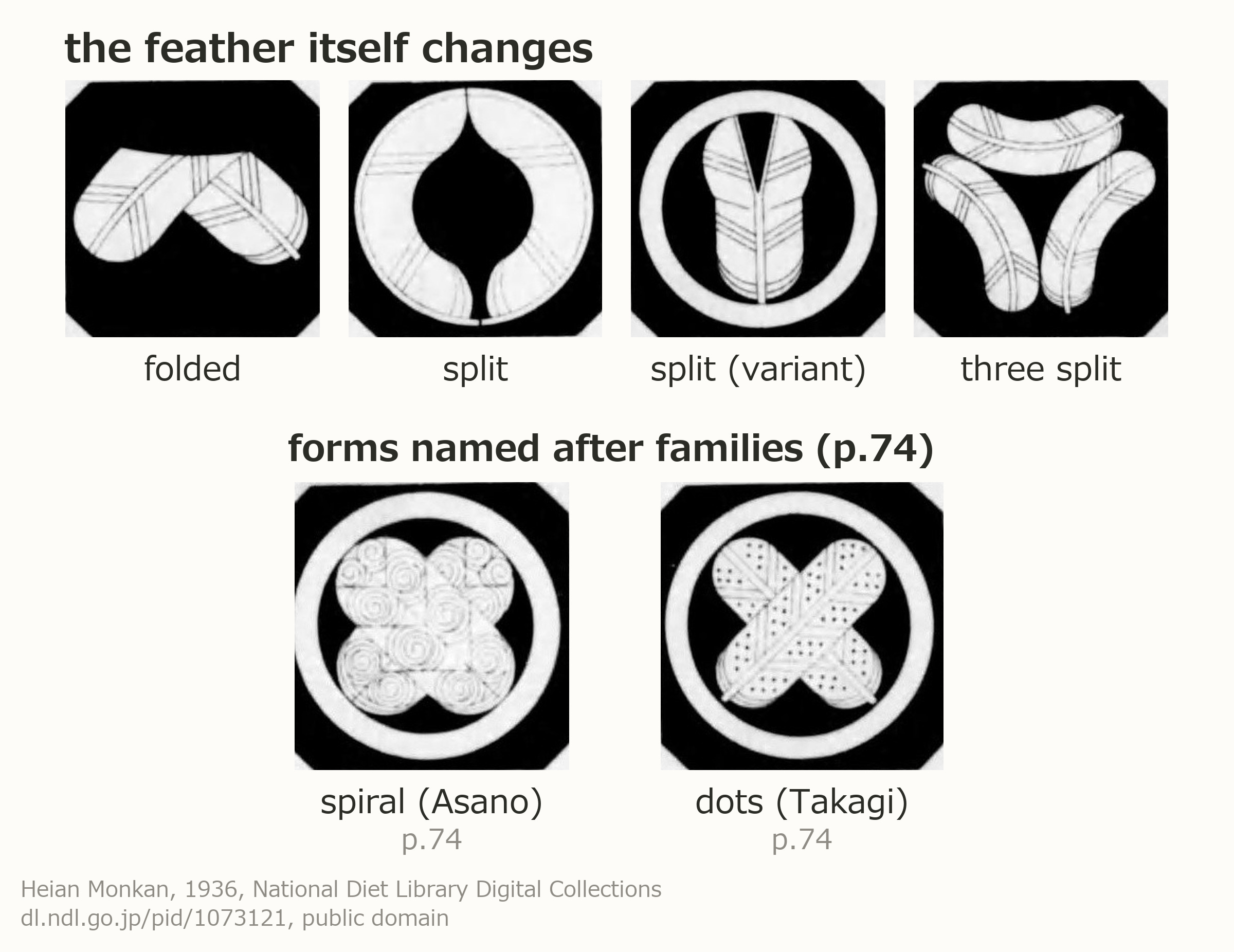
Rule 5 The feather itself changes: dots, spirals, splits, folds
The last method changes the feather itself. Put dots on its surface. Draw a spiral on it. Split it in half. Fold it.
The feather with the spiral was used by the Asano family of the Hiroshima domain and was called the Asano hawk feathers. The feather with the dots was used by the Takagi family of Kawachi, now the eastern part of Osaka Prefecture, and is the Takagi hawk feathers.³ This is the stage where a shape is called by a family’s name.
That is all of the rules. Now, why did they multiply?
Why they multiply: wanting a crest unlike the neighbor’s
What multiplied the feathers was a human concern. People wanted a crest different from the family next door.
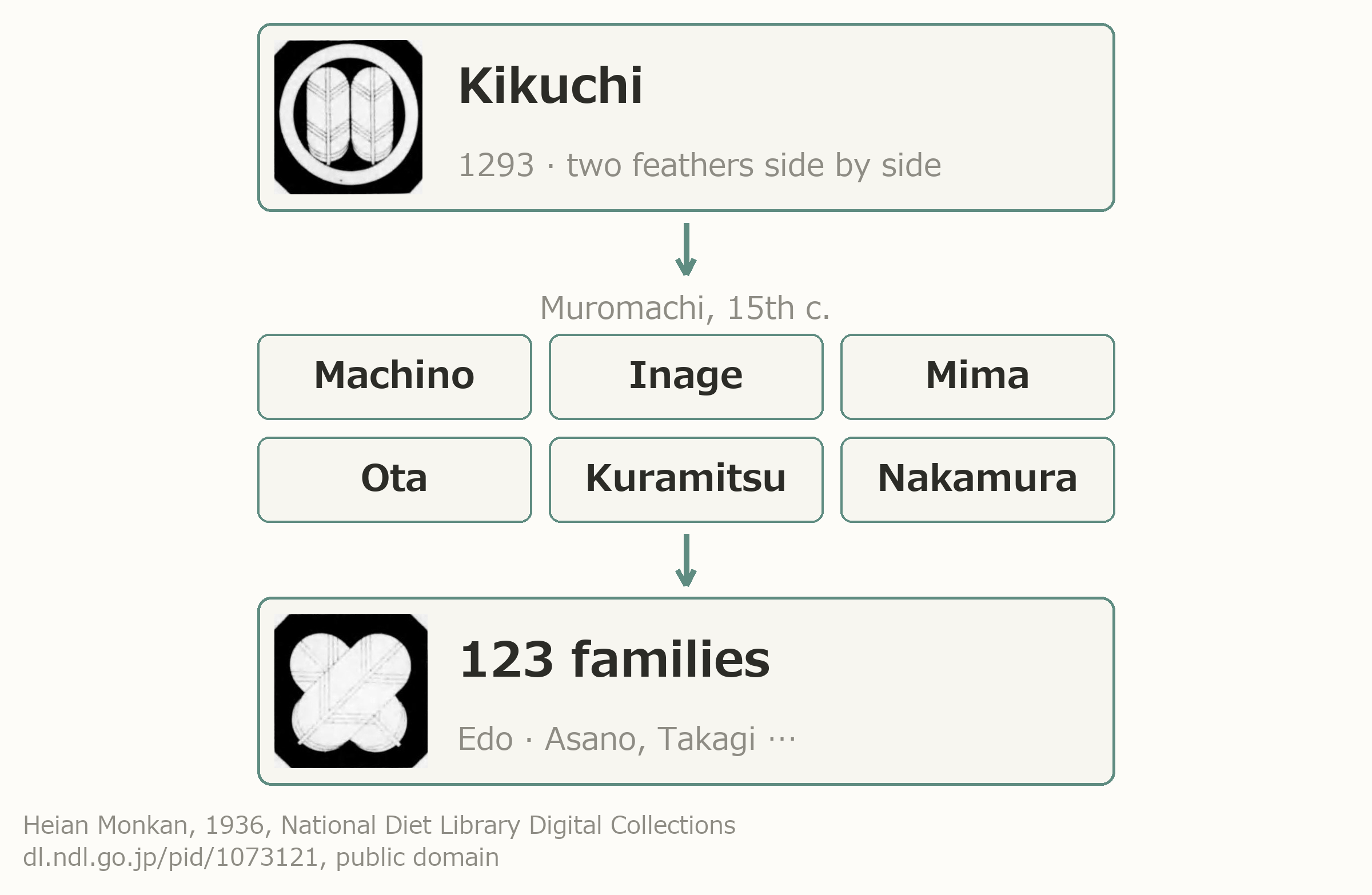
The hawk-feather crest first appears in the record in 1293, in a picture scroll of the Mongol invasions of Japan called Mōko Shūrai Ekotoba. There, the banner of Kikuchi Takefusa, a warrior lord of Kyushu in southwestern Japan, carries two feathers side by side.³ The Kikuchi family tells that the crest was granted by Aso Shrine, the guardian shrine of their clan, according to a chronicle called Hokuhi Senshi.
In the Muromachi period, from the 14th to the 16th century, families outside the Kikuchi bloodline began to use it, among them the Machino, Inage, Mima, Ōta, Kuramitsu, and Nakamura, as listed in Kenmon Shokamon, a record of family crests. By the Edo period, from the 17th to the 19th century, the count reached 123 families among the daimyo, who ruled the domains, and the hatamoto, who served the shogun directly.³
The Asano family of the Akō domain, a branch of the Hiroshima Asano, also bore this crest. Chūshingura, the story of 47 retainers who launched a raid to avenge their lord, is well known in Japan. That lord, Asano Naganori, bore the crossed hawk feathers. After the incident, the Akō hawk feathers spread at once among the townspeople of Edo.⁷
At the time, a kyōka, a short verse poking fun at the news of the day, went around the town of Edo.⁸
The hawk feathers, a crest of mighty force;
the sparrow in bamboo cannot let out a peep.
The hawk feathers stand for the Asano. The sparrow in bamboo stands for the Uesugi, the family now headed by the heir of the Asano’s enemy, Kira Kōzukenosuke. Crest names alone told listeners who the song was about.
With 123 families using the same crest, you cannot tell them apart. You want a crest different from the family next door. That feeling changed the ring, changed the direction, and split the feather.
The books say it was “to tell one’s own from others.”¹ Behind that lies something plainer. It simply wouldn’t do to have the same crest as the neighbor.
The hawk feather is still one of the most common kamon in Japan today. By prefecture it is most common in Chiba, just east of Tokyo, and it clusters in the Kanto region around Tokyo and in Kyushu to the southwest.¹
In the town of Edo, many of the peddlers selling tea whisks, the bamboo tools used to froth matcha, walked about in clothes bearing the crossed hawk feathers. This is a theory introduced by Takasawa Hitoshi in 2021.⁴
A crest used by 123 daimyo and hatamoto families also served as a sign for people selling bamboo tools. A crest belonged to a family, and at the same time it belonged to the town.
The 28 shapes on the two facing pages are the traces of all of that.
To be honest, the only place I remember seeing family crests is in the period dramas that were still on TV when I was in elementary school. I have most likely seen crests on old houses and such, but I could not have told whether any of them was a hawk feather, so the sheer number of varieties surprised me.
How I researched this
The five rules in this article do not appear in any book exactly as presented here.
In 1926, Numata Yorisuke sorted the hawk-feather crests by five actions: stand upright, cross, lay horizontally, arrange in a circle, and liken to other objects. He then wrote separately about differences in the feather itself: dots, spirals, splits, folds. In 2021, Takasawa Hitoshi arranged them by number and placement.⁴
I set these two side by side and reorganized them into five rules. I left out “lay horizontally,” since these two facing pages have no example of it. I made the differences in the feather itself a rule of its own, Rule 5. The rules are used not one at a time but in combination. The diamond, No. 81, is split, folded, and shaped into a diamond: three techniques in one.
The crest images are cropped from the two facing pages of Heian Monkan (1936), held by the National Diet Library and in the public domain.⁹ The count of shapes is my own count of the 28 hawk-feather crests on those pages. The next page continues with 13 more shapes named after families, such as the Asano and the Takagi. This article limits itself to the two facing pages.
Notes
Japanese names in this article are written in the Japanese order, family name first (Numata Yorisuke, Asano Naganori).
The English titles below are my own translations of the Japanese titles, given for convenience. The original Japanese details follow each.
References
¹ The Dictionary of Family Crests (2008) — 高澤等著・千鹿野茂監修『家紋の事典』東京堂出版・2008
² A Survey of Shrine Crests — 丹羽基二『神紋総覧』講談社学術文庫・2016(原本1974)
³ Japanese Heraldry (1926) — 沼田頼輔『日本紋章学』明治書院・1926(第九章 鷹・鷹羽 p.801〜806)
⁴ The Great Dictionary of Family Crests (2021) — 髙澤等『家紋大事典』東京堂出版・2021
⁵ A Cultural History of Family Crests (1999) — 大枝史郎『家紋の文化史』講談社・1999
⁶ Stories of Family Crests (1997) — 泡坂妻夫『家紋の話』新潮選書・1997
⁷ A Dictionary of Family Crest Origins — 丹羽基二『家紋起源事典』青春出版社
⁸ Everything About Family Crests, New Edition (2012) — 『新版 面白いほどよくわかる家紋のすべて』2012(狂歌の出どころ・p.136)
⁹ Heian Monkan, a printed catalog of crests (1936) — 『平安紋鑑』1936・国立国会図書館デジタルコレクション pid 1073121 コマ52〜53(パブリックドメイン)
Kamon Reference is a series of stories about family crests, drawn from Japanese-language books, researched by hyt, who lives in Japan, and edited and translated with help from AI.